| We
forced ourselves to leave our warm sleeping bags at 0230 on June 8th and were
underway at 0300 for St. John’s about 75nm away. The sun leaped into the sky almost
dead in front of Inishfree blasting us with a nuclear intensity as we headed almost
due east towards Cape Race. 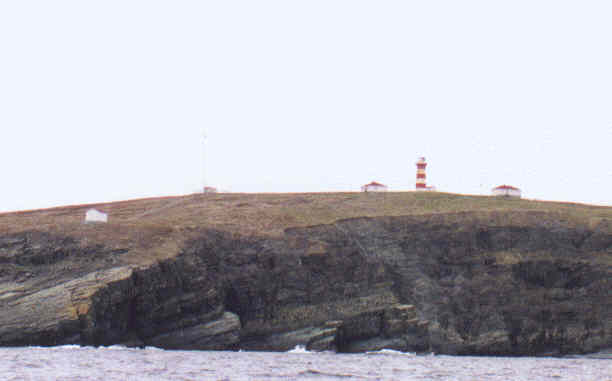 We rounded the Cape at 0700
where we saw several large icebergs grounded along the shore and by our own reckoning
officially entered the North Atlantic Ocean. We toasted the event with a beer while
motoring into a headwind with just the staysail up. Almost immediately after rounding the
cape a dense fog dropped on us like a curtain at the end of a play, bringing visibility
down to less than a quarter mile. The sun was still leaking through from above but was no
help at all in the horizontal view from the water. We fired up the radar and kept what
visual lookout we could through the swirling silver gray. We rounded the Cape at 0700
where we saw several large icebergs grounded along the shore and by our own reckoning
officially entered the North Atlantic Ocean. We toasted the event with a beer while
motoring into a headwind with just the staysail up. Almost immediately after rounding the
cape a dense fog dropped on us like a curtain at the end of a play, bringing visibility
down to less than a quarter mile. The sun was still leaking through from above but was no
help at all in the horizontal view from the water. We fired up the radar and kept what
visual lookout we could through the swirling silver gray.
A little after noon we passed two very large radar contacts at less than half a mile.
We were sure they were icebergs but never saw them. Geoff did not want to change course to
check them out and with the visibility down to next to nothing it was a good decision. The
day wore on while we continued motoring through the gloom. Andy went below for a nap and
Geoff sprawled out like a dead walrus snoozing on the port side bench while I stood radar
watch with the boat on autohelm.
The only break to the visual monotony of the gloom was watching squadrons of Puffins in
wave skimming, butt bouncing, madcap flight with turbo-charged wings generating enough
energy to light a small city, in a great hurry, going nowhere - very fast. After Andy woke
up I went down below for a snooze and sometime later woke up with Andy telling me he had a
radar contact dead on the bow at about 3 miles that he was sure was a huge berg. I
stumbled on deck with my video camera and my 35mm Nikon hoping to get a photograph or two.
As we closed the range to about a mile Andy changed course some so the berg would pass
us close to port and slowed the boat down to about 3 knots. Visibility had condensed to
100 yards so we were going to take this very slowly. I stood up by the port shrouds with
my video camera while Geoff stationed himself portside in the cockpit and Andy watched the
radar and stood by at the helm.
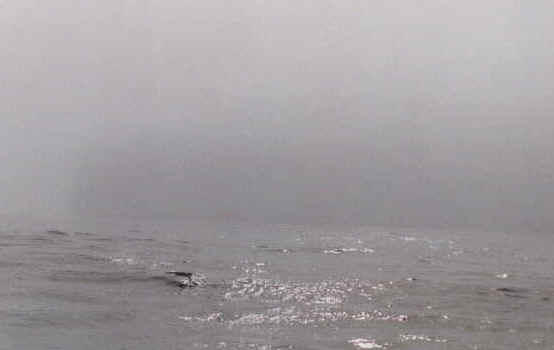 Andy kept a running range and bearing for us while we
strained our eyes trying to pierce the mist. Suddenly Geoff shouted, "There it
is!", and pointed just forward of the port beam. I still couldn’t see a thing.
My eyes finally made out the very subtle distinction of a darker gray taking shape within
the fog not more than 100 yards away. I was awestruck! Andy kept a running range and bearing for us while we
strained our eyes trying to pierce the mist. Suddenly Geoff shouted, "There it
is!", and pointed just forward of the port beam. I still couldn’t see a thing.
My eyes finally made out the very subtle distinction of a darker gray taking shape within
the fog not more than 100 yards away. I was awestruck!
The iceberg was huge. But even this close the fog was still so dense that we could
barely see it. We all just stood there watching this behemoth slide silently by us. It is
very hard to judge things in the fog but by consensus we estimated the berg to be about
100 feet high and 200 feet long with sheer walls and a flat top. The video I shot will
never truly do justice to the sight.
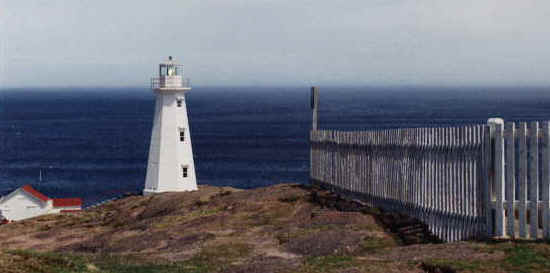 We rounded Cape Spear, the most easterly
point of land in North America, in the fog. Then as quickly as the fog had descended at
Cape Race, it cleared just as swiftly and bathed the entrance to St. John’s in
brilliant sunshine from a sinking sun in the west. The glare was coming directly from the
entrance to the harbor which made it difficult to see an ocean going tug that was
departing St. John’s. We rounded Cape Spear, the most easterly
point of land in North America, in the fog. Then as quickly as the fog had descended at
Cape Race, it cleared just as swiftly and bathed the entrance to St. John’s in
brilliant sunshine from a sinking sun in the west. The glare was coming directly from the
entrance to the harbor which made it difficult to see an ocean going tug that was
departing St. John’s.
The entrance is called ‘The Narrows’ for good reason. Only one large vessel
can enter or leave at any given time. Andy had been monitoring the vessel traffic channel
so we knew the tug was coming out but it was some time before we could find its silhouette
as it slowly made its way out to sea.
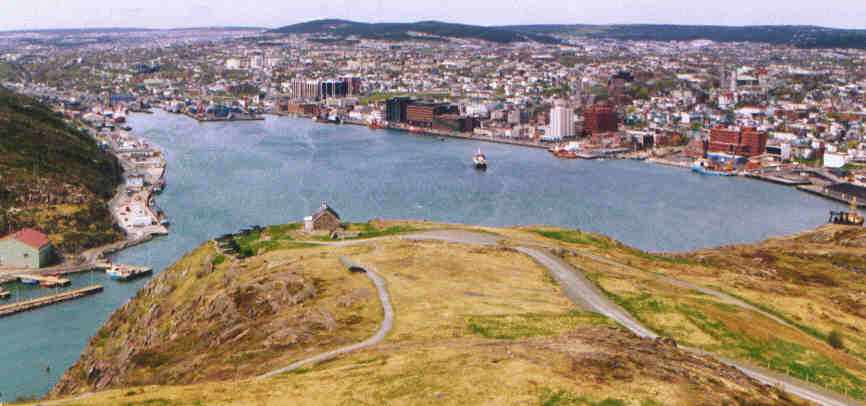 St. John’s
harbor is hidden behind a wall of towering cliffs with a slash of water through them. Once
past the narrows the harbor opens up into a perfectly protected deep water port. The
original discoverer of the harbor must have thought he died and went to Heaven when he
left the stormy North Atlantic for the calm waters that are St. John’s Harbor. I was
glad to be at journeys end but did not really want the voyage to end at all. Andy was
feeling like he had come home again and I think Geoff was mostly thinking about having his
boat to himself again for awhile. Ted Laurentius and his wife Karen were at the dock to
handle lines. St. John’s
harbor is hidden behind a wall of towering cliffs with a slash of water through them. Once
past the narrows the harbor opens up into a perfectly protected deep water port. The
original discoverer of the harbor must have thought he died and went to Heaven when he
left the stormy North Atlantic for the calm waters that are St. John’s Harbor. I was
glad to be at journeys end but did not really want the voyage to end at all. Andy was
feeling like he had come home again and I think Geoff was mostly thinking about having his
boat to himself again for awhile. Ted Laurentius and his wife Karen were at the dock to
handle lines.
We only had to wait a short time for the Customs man to come aboard and check us into
Newfoundland again. We had some doubts as to how he would react when he found out that we
had stopped in Trepassy without checking in with anyone but we figured we could play dumb
(not real far from the truth anyway) and talk our way through any difficulties.
We came clean right from the beginning and told him about our stay at Sainte Pierre and
the horrible crossing of Placentia Bay and our subsequent need for sleep in Trepassy
before making the last leg to St. John’s. He was not real concerned about our
stopover but did want to know what we were bringing into Newfoundland from France. As it
turns out we weren’t on Sainte Pierre long enough to justify the amount of liquor we
were bringing in without having to pay duty. Fortunately, he felt we had earned some
lenience for having made the trip at all in those conditions so he stamped our passports
and wished us a nice stay in Newfoundland.
After that it was a short ride to Ted and Karen’s home. The crew took turns
luxuriating in long hot showers while Karen put together a great dinner. Ted was the
perfect host making me feel right at home from the start. Ted and Andy had some catching
up to do and we all shared stories. One of the treats of the evening came when Ted offered
Brandy over 10,000 year old iceberg ice. The ice becomes a visual and acoustical show of
its own as it pops and crackles and small bubbles escape from the ice as the Brandy begins
to melt it. The ice has a unique taste all of its own. It was the perfect nightcap to end
the voyage to St. John’s.
We were back on Inishfree early the next morning to pack our gear and officially
move off the boat and give Geoff some well-earned solitude. While on board I climbed down
into the lazerette to help reattach the freshwater hose to the pump. The reason it had
come off was because only two screws held the four legs of the Par pump. The Par is a
fairly primitive pump with a large motor that drives a piston attached to a drive belt and
unless it is securely anchored it will shake itself to death. The vibration had literally
yanked the hose and its clamp right off. There was no way to put a screw into all four
legs but I did manage to get three of them anchored. Geoff will just have to keep his eye
on it in the future. After leaving Geoff, Andy and I did the souvenir shopping for people
back home. |